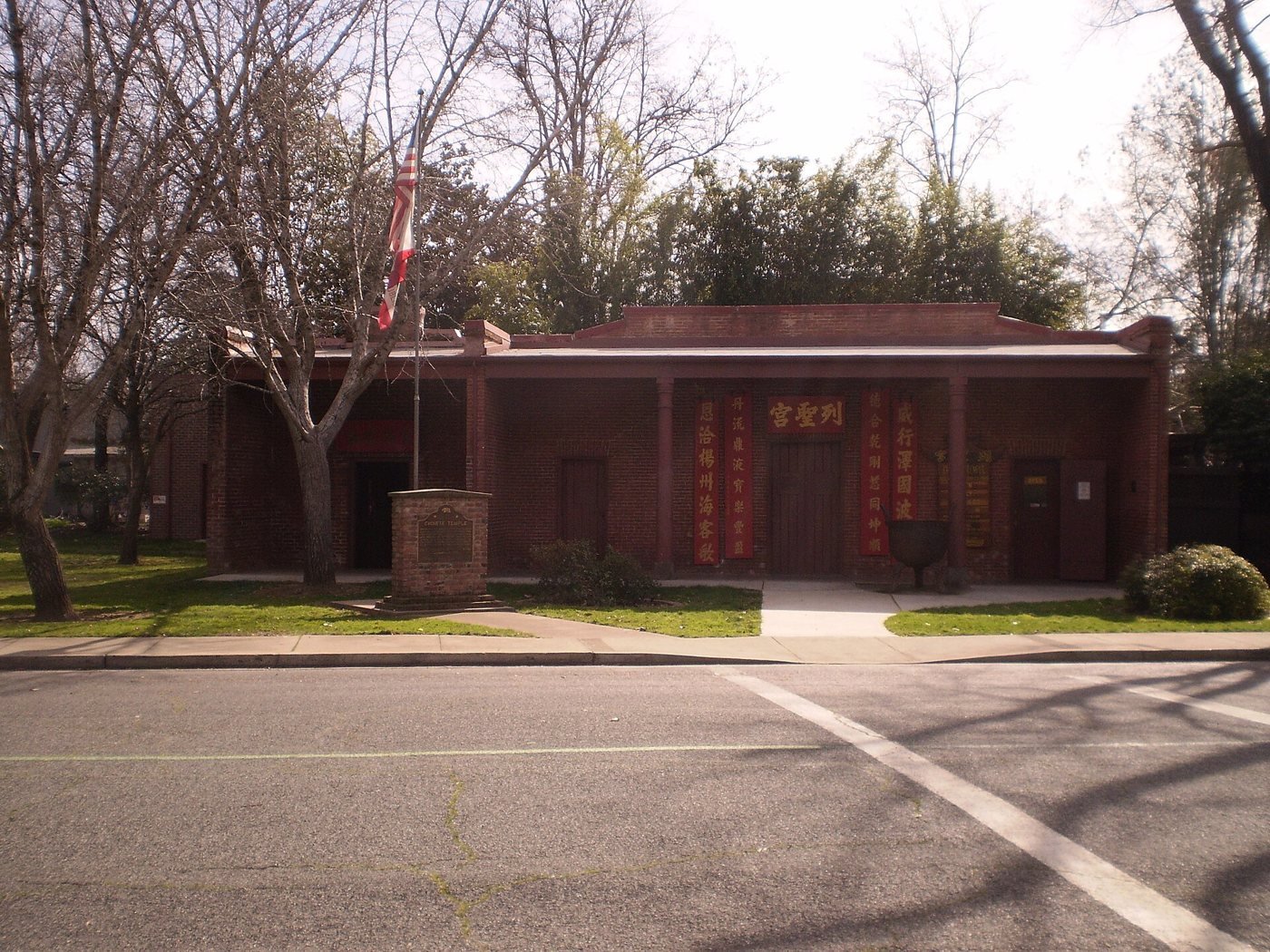
Gold drew thousands to the Feather River after 1848, and Oroville’s Chinese Temple at 1500 Broderick Street still stands from those years. The State of California dates it to the spring of 1863; the City of Oroville says 1873. It is open Saturdays and Sundays, 11:00 a.m. to 3:00 p.m., February through December, per the city.
The Short Version
John Bidwell found gold on the Feather River in 1848 at the spot later called Bidwell Bar, helped by Mechoopda workers. Chinese miners and merchants built a large community in Oroville, and its temple became a state landmark in 1962. The Chinese residents deeded it to the city in 1935, and it first opened to the public in 1949. Today it is a working temple and a museum.
| Date | What happened | Source |
|---|---|---|
| 1848 | Bidwell mines the Feather River at what became Bidwell Bar; the Mechoopda Tribe says his Native workers helped extract some $100,000 in gold in 1848 and 1849. | Mechoopda Tribe; Town of Paradise |
| Spring 1863 | The temple is dedicated as a place of worship for 10,000 Chinese then living in Oroville. | State Office of Historic Preservation |
| 1873 | The City of Oroville gives this as the year the temple was built. | City of Oroville |
| 1935 | Chinese residents deed the building to the City of Oroville. | State Office of Historic Preservation |
| 1949 | The temple first opens to the public, during the Centennial. | City of Oroville |
| January 31, 1962 | Registered as California Historical Landmark No. 770. | State Office of Historic Preservation |
| 1968 | Tapestry Hall is added. | City of Oroville |
| 2008 | The Fong Lee Company Building is completed. | City of Oroville |
Gold on The Feather River
The Town of Paradise’s history says Bidwell was at Sutter’s Fort when gold was found in January 1848, then headed north and “found wealth at what became Bidwell’s Bar.” The Mechoopda Tribe’s history adds the other side: many Mechoopda went with Bidwell to the Feather River and were paid in trade goods, while mining silted the streams and hurt the salmon runs they relied on. Prospectors worked every canyon along the Feather River in 1849 and 1850.
The Temple on Broderick Street
The city calls the temple “both a living place of worship and a fascinating museum,” built for the largest Chinese community north of Sacramento. The main temple, Liet Sheng Kong or “Temple of Many Deities,” honors several Eastern religions, with separate Confucian and Buddhist temples beside it. Tapestry Hall holds embroidered art, ceremonial parasols and clothing from 1850 to 1930. The Fong Lee Company Building shows goods from a herb shop and gold exchange run by the Chan family, and the garden has bamboo planted in the 1860s.
Visiting The Temple
| Item | What the City of Oroville prints | Source |
|---|---|---|
| Hours | Oroville Chinese Temple (February-December), Saturday & Sunday, 11:00 a.m.-3:00 p.m. | City Museums page |
| Admission | Admission (Cash Only): $4 Adults, $3 Seniors, children under 12 are free | Chinese Temple page |
| Address | 1500 Broderick Street, Oroville, CA 95965 | Chinese Temple page |
| Phone | 530-538-2496 | Chinese Temple page |
| Closures | City Museums are closed on federal holidays. If a museum is closed during normal hours, it may be due to a lack of available volunteers. | City Museums page |
The city runs five museums within a mile of each other downtown, its “Museum Mile,” including the Pioneer History Museum and the C.F. Lott Home.
Chico Legend
The Emperor of China Paid for Oroville's Temple
A favorite Oroville story says the money for the temple came all the way from the Emperor and Empress of China. Could that be true?
Believe it? Make your guess, then open the answer.
Show What Is Actually True
What is actually true: It is what the State of California's landmark record says: “Funds for its erection and furnishings were provided by the Emperor and Empress of China – local Chinese labor built the structure.” We have not found the original record of the gift, so it is the state's account rather than something we could check ourselves. Even the build date is in dispute: the state says 1863, the city says 1873.
Sources: California Office of Historic Preservation, California Historical Landmark No. 770, Chinese Temple; City of Oroville, Chinese Temple facility page
Questions People Ask
When Is The Oroville Chinese Temple Open?
Saturday and Sunday, 11:00 a.m. to 3:00 p.m., February through December, per the City of Oroville. It closes on federal holidays and sometimes when volunteers are short.
How Much Is Admission?
$4 adults, $3 seniors, children under 12 free, cash only.
How Old Is The Temple?
The state landmark record says it was dedicated in spring 1863; the City of Oroville says it was built in 1873.
What Is Bidwell Bar?
The spot on the Feather River where John Bidwell found gold in 1848.
Still Unconfirmed
- Not confirmed Whether the temple dates to 1863 (State of California) or 1873 (City of Oroville).
- Not confirmed The date of the next Chinese New Year celebration and Lion Dance at the temple; the city has not posted it on the pages we read.
- Not confirmed The original record of the Emperor and Empress of China funding the building.
More Chico History
-
Oroville Dam and Lake Oroville History
The tallest dam in the country, finished in 1967 on the Feather River.
-
Paradise and The Ridge: History and Rebuilding
Dogtown gold, the town's name and how Paradise is rebuilding after 2018.
-
Chico History Timeline
Around 50 dated moments from the Mechoopda village to the Reimagine Bidwell Mansion plan.
-
Chico Legends: True or Tall Tale?
Seven local stories, each checked against the record.
Sources
- California Office of Historic Preservation, California Historical Landmark No. 770, Chinese Temple, read October 29, 2026.
- City of Oroville, Chinese Temple facility page, read October 29, 2026.
- City of Oroville, City Museums, read October 29, 2026.
- Mechoopda Indian Tribe, Euro-American Contact, read October 29, 2026.
- Town of Paradise, Community (town history), read October 29, 2026.
Cite this page: It's Chico, “Oroville Gold Rush and The Chinese Temple”, itschico.com/history/oroville-chinese-temple/ (updated ). By the It's Chico editorial team. Free to quote with attribution and a link to this page; data and tables are licensed CC BY 4.0.